Serbia country guide Places and experiences
What should a first-time traveler see in Serbia beyond the obvious highlights?
The short answer
The monastery heartland, the great gorge and the vulture canyon: Studenica and Sopoćani in the southwest, the Iron Gates of the Danube with Golubac Fortress and Lepenski Vir, the Uvac meanders, Fruška Gora's monasteries and wine, and Niš — Constantine's birthplace — in the south.
The answer, with local context
Serbia's sacred geography sits in its southwest. Studenica Monastery (founded by Stefan Nemanja in the late 12th century; UNESCO 1986) is the dynasty's mother house — white marble churches holding 13th- and 14th-century Byzantine painting that UNESCO calls priceless — and its sister inscription, Stari Ras and Sopoćani (1979), guards the first Serbian capital and frescoes of about 1265 that art historians rank with anything in Byzantium. Between and beyond them runs the Ibar valley of kings: Žiča, Gradac, and the fortified Maglič castle above the river gorges. North of Belgrade, the low wooded mountain of Fruška Gora — Serbia's oldest national park, declared in 1960 — holds 16 surviving Orthodox monasteries among vineyards that have poured wine since Roman Sirmium (modern Sremska Mitrovica, a Roman imperial capital where several emperors were born); Sremski Karlovci, its baroque wine town, is famous for Bermet, the spiced dessert wine once sent to the Habsburg court.
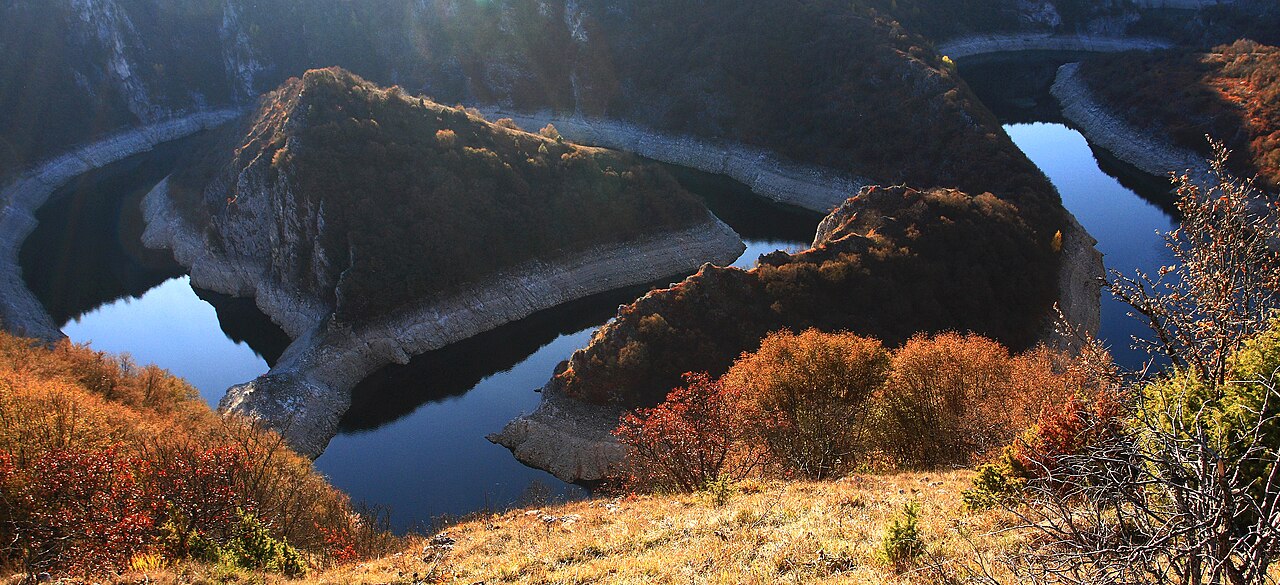
The east is the Danube's epic. At the Iron Gates, the river forces 100 km of gorges through the Carpathians in Đerdap National Park (Serbia's largest, at over 63,000 hectares): Golubac Fortress, 14th-century towers rising straight from the water at the gorge's gate; Lepenski Vir, the Mesolithic fishing settlement of sculpted boulder heads (occupied from about 9500 BC, excavated in the 1960s before the Đerdap dam raised the river); and Trajan's Plaque, the Roman emperor's road inscription of about AD 100, reachable by boat. Zaječar adds Gamzigrad-Romuliana, the fortified palace Emperor Galerius built in the late 3rd and early 4th centuries and named for his mother (UNESCO 2007). The southwest answers with water of its own: at Uvac, a special nature reserve of 7,543 hectares protects a limestone canyon 200–350 m deep whose pinched meanders turn through 270°, and the griffon vulture colony the reserve's wardens rebuilt — by 2017 some 110 nesting pairs and almost 500 birds, the Balkans' largest colony — with the Ušac cave system (6+ km) under the rim. Beside it, Tara National Park holds the Drina canyon and the celebrated house on a Drina rock at Bajina Bašta (first built 1968, swept away and rebuilt by floods ever since), and the stećci tombstone sites at Perućac belong to Serbia's 2016 transnational UNESCO inscription.
The south completes the circuit: Niš, Roman Naissus, birthplace of Constantine the Great, keeps his Mediana villa's mosaics and the Skull Tower (Ćele-kula) of 1809 — a tower the Ottoman commander built from the skulls of Serbian rebels after the Battle of Čegar, of which about 59 skulls remain embedded today — history at its most unflinching, 2 hours from the capital. Subotica in the far north counters with Hungarian Secession architecture and its 1902 synagogue, and Đavolja Varoš (Devil's Town) near Kuršumlija raises 202 eroded stone pyramids in a ravine. The beyond-Belgrade Serbia is not a garnish; it is most of the country.
Picture the place
A boat under Golubac at first light: 9 towers stepping down the rock into a Danube gone perfectly still, the gorge ahead narrowing to a green slit, and swallows pouring out of the fortress walls.
The easily missed detail
Lepenski Vir's address moved: the original settlement terrace was flooded by the Đerdap reservoir, and the site you visit is the whole village lifted and rebuilt above the waterline in the 1970s — the famous fish-headed sculptures are originals, the ground under them is a rescue. The second miss is at Sopoćani: the monastery's church is a living house with services, and its world-class frescoes are best in morning light before the tour buses from the coast arrive — the southwest rewards the early riser in a way the capital never asks.
A practical rhythm
- A southwest monastery loop — Studenica, Žiča and Sopoćani strung over 2 days from a Kraljevo or Novi Pazar base
- The gorge by water — Golubac and Lepenski Vir combined with a boat under Trajan's Plaque
- Uvac at midday — The vultures ride thermals from late morning; the viewpoint and boat timed to the colony's working hours
What could complicate the plan
Serbia's beyond-highlights are road sights: the southwest's monastery roads are mountain two-laners, the Iron Gates road threads tunnels and rockfall zones with closures after storms, and Uvac's viewpoints are reached on local lanes and footpaths. The Iron Gates sits on the Romanian border — the gorge road and boats run under border-zone rules, passports should be carried, and some riverside stops need the reserve's arrangements. Working monasteries impose their own terms everywhere: dress codes, photography limits, and services that close churches to touring at exactly pilgrimage peaks (Studenica's feasts fill its guesthouse months ahead; monastic accommodation is booked through the monasteries, not apps). The Medieval Monuments in Kosovo inscription (2004, on the danger list) is administered in a territory Serbia claims but does not control — visits there are a separate political and logistical undertaking, not a Serbia road-trip extension, and this guide does not route through it.
What to do next
Choose 2 of the 3 arcs (southwest monasteries, Iron Gates, Uvac–Tara) plus Fruška Gora as the easy win, and give each its own overnight base.
Sources
- UNESCO World Heritage Centre — Studenica (1986); Stari Ras and Sopoćani (1979); Gamzigrad-Romuliana (2007); Stećci (2016); Serbia country page (5 properties)
- Institute for Nature Conservation of Serbia / Uvac Reserve — the reserve's 7,543 hectares, canyon dimensions and the griffon vulture colony's recovery (110 pairs, ~500 birds by 2017)
- Đerdap National Park — the park's extent (over 63,000 hectares), Golubac, Lepenski Vir and Trajan's Plaque
- National Museum / Niš tourism — Constantine's Naissus, Mediana and the Skull Tower (1809; ~59 skulls remaining)