Slovenia country guide When to visit
When is the best time to visit Slovenia for Lake Bled?
The short answer
The last 2 weeks of June — the lake is at swimming temperature, the Julian Alps around Bled are in alpine flower, every gorge, cave and mountain road in the country is open, and Ljubljana and the coast are in full summer without August's crush.
The answer, with local context
Slovenia is Europe's green compression trick: 20,273 km² holding an Alpine northwest, a Karst southwest, a sliver of Adriatic and Pannonian plains — more than 60% of it forested, the 3rd-highest share in Europe, and a single national park, Triglav (protected first in 1924, given its modern 840 km² form by the 1981 act, and a UNESCO biosphere reserve since 2003), guarding the Julian Alps around Triglav itself at 2,864 m. June is when all 4 of its landscapes switch on at once: the Alpine valleys are at their highest water (the Soča running emerald, Vintgar Gorge's boardwalks open by Bled, the Tolmin Gorges in Triglav National Park passable), the Karst caves and Piran's 46.6-km coastline are warm, and the plains' wine towns are between blossom and harvest crowds. Entry is unremarkable in the best way — EU, Schengen and euro (Slovenia was the first of the 2004 EU entrants to adopt it, in 2007): the U.S. Department of State confirms U.S. citizens stay 90 days in any 180 without a visa, passport 3 months beyond departure. Slovenia holds 5 UNESCO properties — the works of Jože Plečnik in Ljubljana (2021), Škocjan Caves (1986), the Idrija mercury heritage (2012), the Alpine pile dwellings (2011) and the primeval beech forests (2017) — and late June serves every one of them in daylight that lasts past 9 p.m.
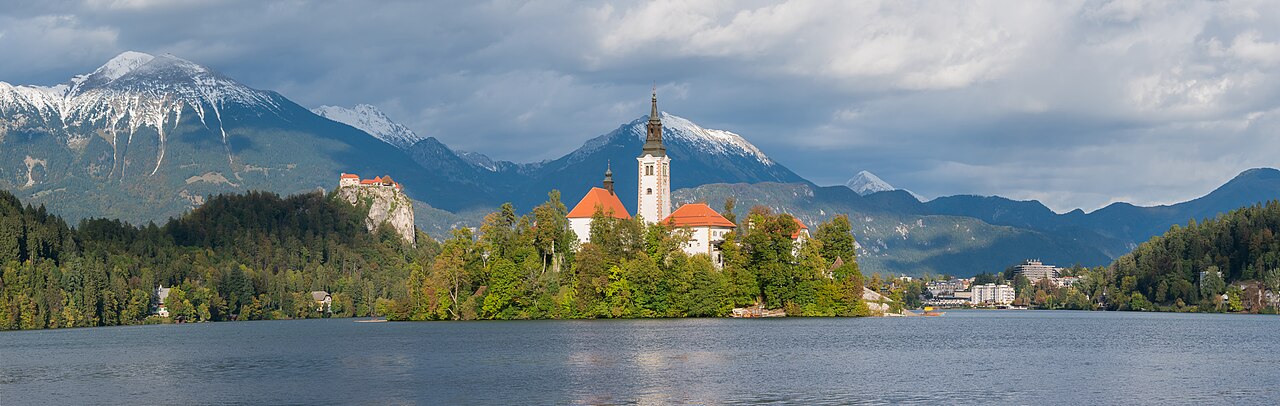
Now the anchor, because Bled is a place with a mechanism. The lake is small (2.1 km long) and runs on ritual: the flat-bottomed pletna boats, rowed standing by pletnarji whose right descends from an 18th-century grant to 23 local families, ferry you to Slovenia's only island, where 99 stone steps (built 1655) climb to the Assumption church and its wishing bell, cast in Padua in 1534 — ring it, by legend, and the wish holds. Bled Castle, Slovenia's oldest (first documented in a deed of May 22, 1011), watches from 130 m of cliff. Late June is Bled's exact sweet spot: the lake's surface reaches about 72°F (22°C), warm enough for the swimming areas at the castle beach and Velika Zaka; the 6-km lakeside path and the Mala Osojnica viewpoint are crowd-light on weekdays; the rowing season is in regatta trim; and the famous cream cake (kremna rezina, baked at the Park Hotel since 1953) tastes the same as in August with half the queue. From Bled, June unlocks the near Alps without effort: Lake Bohinj, bigger and wilder inside the national park, 25 minutes away; the Savica waterfall at full flow; Pokljuka's meadows flowering.
The rivals: September is magnificent (Bohinj's Cow Ball, when the cattle come down, lands mid-month; the wine regions harvest; Bled stays swimmable) and it is the honest second choice — it loses only the longest days and the highest waterfalls. July–August bring the Ljubljana Festival in full but also Bled's coach-park peak and Soča-valley crowds. Winter inverts the country (Kranjska Gora and Vogel ski; Bled's island in frost is a different, beautiful trip). But the fortnight when lake, Alps, karst and coast all say yes at once is late June.
Picture the place
The island from Mala Osojnica at 8 on a June evening: the church tower in gold leaf light, 2 pletne crossing the flat water with their striped canopies, and the Karawanks holding snow above the tree line.
The easily missed detail
Bled's island has opening discipline: the church keeps seasonal hours (longest in summer, roughly 8:30 a.m.–7 p.m. in season) and the pletna gives you about 40 minutes on the island — enough for the steps, the bell and the tower, not for dawdling, so the cream cake and castle are sequenced before or after, never between boats. The second miss is Vintgar: the gorge 4 km from Bled now runs a timed, one-way system in season, and the traveler who arrives at noon walks it in a procession; at opening time it is a private river.
A practical rhythm
- Bled on weekdays — The island and castle given a Tuesday-to-Thursday window, swims at either end of the day
- Bohinj as the wild twin — 1 full day up the valley: Savica, the lake, the Vogel cable car
- The capital in the evenings — Ljubljana's riverside season used as the trip's dining room, 55 km away
What could complicate the plan
June in the Julian Alps is luminous but not stable: the month's weather pattern is fine mornings and convective afternoon storms, and the high trails around Triglav still carry snowfields into early summer (Triglav itself is a via-ferrata mountaineers' summit, not a walk — the park's low point is 180 m at the Tolmin Gorges and its weather scales accordingly). Bled's weekends are the exception to the shoulder-season calm: Ljubljana and Austrian day traffic fills the lakeside by 11 a.m. on Saturdays. The Vršič Pass (1,611 m, 50 hairpin bends) between the Bled side and the Soča opens seasonally and can still close overnight on a late snow. And the country's size tempts cramming: a 25-mile hop on the map is an Alpine hour on the road.
What to do next
Book the fortnight from mid-June, sleep in Bled or Bohinj (not Ljubljana) for the lake days, and ring the bell before 10 a.m.
Sources
- Triglav National Park Public Institute — the park's area (83,982 ha, 4% of Slovenia), protection since 1924, the 1981 act, Triglav at 2,864 m and the UNESCO biosphere reserve (2003)
- UNESCO World Heritage Centre, Slovenia — 5 properties: Plečnik's Ljubljana (2021), Škocjan (1986), Idrija mercury (2012), pile dwellings (2011), beech forests (2017)
- Bled Tourism / Bled Castle — the castle's first documentation (1011), the island church's 99 steps (1655) and the 1534 wishing bell; the pletna tradition
- U.S. Department of State, Slovenia travel information — Schengen 90/180 visa-free entry; passport 3 months beyond departure