Tuvalu country guide Trip planning
How can I plan a memorable first trip to Tuvalu without rushing?
The short answer
Give Tuvalu the flight-shaped trip it demands: 9–12 nights between Fiji Airways' 3-weekly Suva services, all but a few nights on Funafuti, 1 outer island if the government ship's 3–4-week cycle aligns, AUD cash in hand, and the permit's month as your safety margin.
The answer, with local context
Tuvalu planning is a study in small numbers: 1 airline (Fiji Airways from Suva's Nausori Airport, about 3 flights a week, roughly 2.5 hours), 1 airport (Funafuti International, code FUN), 1 hospital, 2 hotels and a row of family guesthouses, about 10,600 citizens and a few hundred visitors a year (the country regularly tops "least visited nation" lists with annual arrivals in the low thousands). Entry is simple but not free (this guide's first answer): passport valid 6 months, onward ticket, proof of funds, a visitor permit for up to 1 month issued on arrival at AUD 100, extensions at the immigration office. Money is Australian dollars in cash (there are no international ATMs; the National Bank of Tuvalu changes money; cards are near-useless) — bring the whole trip's cash from Fiji, in notes Tuvaluan shops can change. The Falepili Union (the 2023 Australia–Tuvalu treaty on climate mobility and security) and the digital-nation programme mean your visit sits inside a live national story: behave as a guest in a country negotiating its future, not as a sightseer at a sinking set — recent research, for the record, finds most Tuvaluan islands' land area stable or growing over recent decades even as sea level rises, and Tuvaluans prefer the conversation to start from resilience (the word falepili itself means standing shoulder to shoulder).
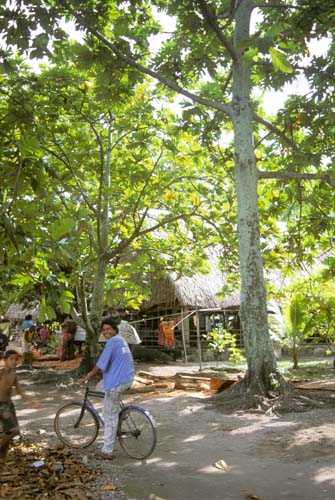
Build the days around Funafuti's grain: arrive Tue/Thu/Sat; settle at the Vaiaku Lagi or a guesthouse; day 2, the island end-to-end (Fongafale is some 12 km of road — walk it, cycle it, bus it; the island is 200–400 m wide, ocean on one side and lagoon on the other, and you cannot get lost). Book the conservation-area boat early in the stay (weather spare days behind it), evenings on the airstrip, a Saturday at the market and handicraft center, Sunday in church (EKT — the Ekalesia Kelisiano Tuvalu — is the country's heartbeat; visitors dressed modestly are genuinely welcome and the singing repays everything). If, and only if, a government ship sails in your window, take the northern run (Nanumea, 3–5 days out) or the southern (Nukufetau/Vaitupu), accepting the ship's calendar wholesale — this is the Pacific's last scheduled-passenger-ship adventure in its honest form. Keep the final 2 nights on Funafuti regardless (the ship, the weather and the flight all answer to the sea), and fly out on a service that leaves a spare flight before any hard commitment in Fiji. Deposit your flexibility in writing: tell the guesthouse, the boatman and yourself that plans here are tide tables, not contracts.
Picture the place
Your last evening on Fongafale's ocean side: the reef booming white in the trade swell, children riding the lagoon side in the last light, and the whole country — 12 km of it in view — going about its evening like a village that happens to be a nation.
The easily missed detail
The airstrip is the social contract: built by Americans in 1943, it is now Funafuti's largest public space — volleyball and kilikiti on non-flight evenings, families promenading, teenagers cycling its length — and when a flight is due, a siren and a sweep clear it in minutes. The traveler who treats the runway as a park-with-rules (play freely, scatter when the siren sounds) understands Tuvalu faster than any briefing. The second detail is the stamp economy's persistence: the Philatelic Bureau still issues Tuvalu's elaborate commemoratives, first-day covers are a national craft, and a morning buying stamps at the bureau window (and mailing a postcard that will travel further than you) is the cheapest perfect souvenir mechanism in the Pacific.
A practical rhythm
- 9–12 nights, flight-shaped — In on a Tuesday, out the Saturday week: the pattern the airline built for you
- Funafuti as base, ship as lottery — The outer island is a bonus when the sailing aligns, never the plan's spine
- Cash complete on arrival — Every AUD the trip needs, carried in, in small notes
What could complicate the plan
Flight risk concentrates everything: a cancelled Tuesday service can mean Thursday, a mechanical in Suva can eat 3 nights, and seats in school-holiday and government-travel peaks vanish — buffer in Fiji on both ends and insure for delay, not just disaster. The permit's fee and terms changed recently (AUD 100; older free-entry lore persists online — Re-verify at booking), overstaying is fined by the day, and the extension conversation happens at a Funafuti office in office hours — have the talk before any ship sails. Supply-chain reality: fuel, food variety, even beer arrive by the same monthly rhythm; a dry tank, a broken generator or an empty store shelf is logistics, not neglect, and the guest who packed patience (and their own medication, sunscreen and spares — there is no pharmacy row) sails through. Connectivity is satellite-thin and priced accordingly (local SIMs exist; video calls are a fantasy — tell home you'll be quiet, and be delighted by it). Finally, the respectful-visitor rule for the climate story: ask before photographing TCAP works or flooded pits, listen more than you pronounce, and don't tell Tuvaluans their country is disappearing — they are mid-argument with the future, and visitors are welcome on the resilience side of it.
What to do next
Book the Suva–Funafuti flights first (a Tue-in/Sat-out pairing), carry the trip in AUD cash, and check the wharf's sailing board within an hour of landing.
Sources
- U.S. Department of State, Tuvalu — visitor permit up to 1 month (AUD 100 fee); passport 6 months; onward ticket; consular coverage from Suva
- Fiji Airways — Suva–Funafuti about 3 times weekly (about 2.5 hours)
- Tuvalu National Statistics Office, 2022 census — population about 10,600; Funafuti about 6,000
- Historical/policy record — the Australia–Tuvalu Falepili Union (2023); the Future Now digital-nation project; the 1943 U.S. airfield
- Ocean-science record — Funafuti tide-gauge rise above the global mean; island land-area stability/growth studies