Tuvalu country guide When to visit
When is the best time to visit Tuvalu for Funafuti lagoon?
The short answer
August — the deep trade-wind dry season, with Funafuti's lagoon at its calmest and clearest, the westerly squalls and cyclone risk of November–April behind you, and king-tide season a full half-year away.
The answer, with local context
Tuvalu sits just south of the equator, and its year runs on wind rather than temperature: highs hold 82–88°F (28–31°C) essentially every day of every month. From May to October the easterly trades steady the atoll — rain eases (Tuvalu still takes a generous 3,000 mm-plus a year, so "dry" here means drier), the lagoon inside Funafuti's reef flattens, and boat days to the western islets run on schedule. From November to April the westerlies bring heavier rain, boisterous lagoon weather and cyclone risk; February–March add the year's king tides, when the highest springs push seawater up through the porous coral itself — flooding the borrow pits (the WWII-era excavation hollows across Fongafale) and ponding around the runway edges. August is the antipode of all that: maximum distance from both the cyclone core and the king tides, and the lagoon — Te Namo, some 275 km² of enclosed water against barely 2.4 km² of Funafuti dry land — at its glassy best for the anchor's pursuit, the Funafuti Conservation Area: a boat ride of about 15 km across the lagoon to the western rim, where the Kogatapu protects 33 km² of reef, lagoon and 6 uninhabited islets — roughly 20% of the atoll's reef area — as a no-fishing zone. The published authority facts: the Conservation Area was created by the Kaupule o Funafuti (the island council) under Tuvalu's Conservation Areas Act, its order taking effect December 1, 1999, after a project begun in 1996 with SPREP support; surveys in 2007 already showed grouper and snapper grown large under the closure; the islets (Tepuka, Fualopa, Fuafatu among them) nest green turtles and host a black noddy colony. Entry rules complete the MUST bundle: the U.S. State Department records a passport with 6 months' validity, an onward/return ticket and proof of funds, with a visitor permit valid up to 1 month issued on arrival for a fee of AUD 100 (recent changes raised it from free — carry the cash and expect the new price).
August's other arithmetic is the flight board: Fiji Airways flies Suva–Funafuti only about 3 times a week (the pattern has long been Tuesday/Thursday/Saturday from Nausori, about 2.5 hours), and your month choice is really a seat choice — August seats sell to government travel, aid rotations and returning Tuvaluans, so the season argues for booking the moment you choose it. Around the lagoon days, Funafuti's social calendar runs on the airstrip itself: on non-flight evenings the runway becomes the capital's sports ground and promenade, and August's dry evenings are its high season. A country with no rivers, no hills and (an honest planning fact) no UNESCO sites at all offers its sublime in 1 medium — water — and August is when that water is kindest.
Picture the place
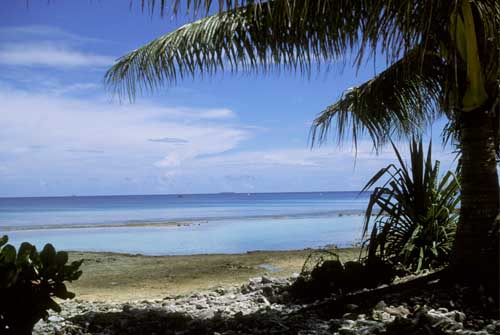
A boat crossing Te Namo at 8 a.m.: the lagoon the color of bottled glass to the western reef, Tepuka's palms growing out of the haze, and your wake the only line on 275 km².
The easily missed detail
The conservation area is customary law wearing a statute's clothes: the reserve exists because Funafuti's own kaupule (elders and council) declared and police it, rangers patrol in the council's boats, and visiting boats pay a conservation fee that funds the patrols — ask at the council or your hotel, pay gladly, and understand that landing on the islets is by permission and habit, not by right. The second detail is tidal: the Funafuti tide gauge is one of the Pacific's long climate records, sea level here has been rising at a rate well above the global mean across its record (roughly 3.9 mm a year in recent analyses), and the raised-land platform built by the Tuvalu Coastal Adaptation Project (about 7.8 ha of new, flood-free land completed in 2023 near the government center) is the country's answer being poured in real time — a construction site that is also a national manifesto, worth the walk.
A practical rhythm
- Mid-August window — A Tue-in/Sat-out or Thu-in/Tue-out flight pairing for 9–11 nights
- Conservation Area early — Book the western-reef boat day for your first calm morning, not the last
- Runway evenings — Volleyball and soccer on the strip at dusk: the capital's true civic hour
What could complicate the plan
The flight is the plan's single point of failure: 3 services a week, 1 airline, weather and operational cancellations that strand you for days, and a permit (1 month) generous enough to absorb it — the practical rules are to book early, reconfirm relentlessly, and never place a same-day onward connection in Suva or Nadi. The permit fee changed recently (older guides still say free; the State Department's AUD 100 is the current planning figure — carry Australian cash, as Tuvalu runs on AUD and Funafuti's card machine is a fair-weather friend). Health cover is thin by design: Princess Margaret Hospital is the country's only hospital, the U.S. Embassy covering Tuvalu sits in Suva, and anything serious is a flight to Fiji or beyond — evacuation insurance sized accordingly. King tides and cyclones bracket the year away from August, but even August trades can chop the ocean-side passes (Te Ava Fuagea, the deep entrance) enough to cancel conservation-area boats on a windy day — build 2 spare lagoon days. And a gentle one: Funafuti is small (6,000 people) and watchful in the kindest way — alcohol is sold at few outlets, Sunday is church-quiet, and the visitor who greets in Tuvaluan (talofa) and dresses modestly off the beach is adopted instantly.
What to do next
Pick an August Tue/Thu/Sat flight pairing, book the Vaiaku Lagi or a family guesthouse the same day, and reserve a conservation-area boat for your second morning.
Sources
- U.S. Department of State, Tuvalu — passport valid 6 months; onward ticket and proof of funds; visitor permit up to 1 month issued on arrival for AUD 100; consular coverage from the U.S. Embassy in Suva
- Government of Tuvalu / Kaupule o Funafuti — the Funafuti Conservation Area (33 km²; 6 islets; about 20% of the atoll's reef; order in force December 1, 1999 under the Conservation Areas Act; no-fishing rules and ranger patrols)
- Tuvalu Meteorological Service / climate guides — drier trade season May–October; wetter season November–April with cyclone risk; king tides February–March; temperatures 82–88°F (28–31°C) year-round
- Fiji Airways — Suva (Nausori)–Funafuti about 3 times weekly, about 2.5 hours
- Tuvalu Coastal Adaptation Project (UNDP/Green Climate Fund) — about 7.8 ha of raised land completed 2023