Tuvalu country guide Places and experiences
What should a first-time traveler see in Tuvalu beyond the obvious highlights?
The short answer
The WWII layer under the airstrip (David's Drill, bunkers and lagoon wrecks), the Nanumanga fire caves' sea-level mystery, the philatelic bureau's stamp economy, and 8 outer islands reached by government ship: Tuvalu beyond Funafuti's beach is a war museum, a science site and a second country afloat.
The answer, with local context
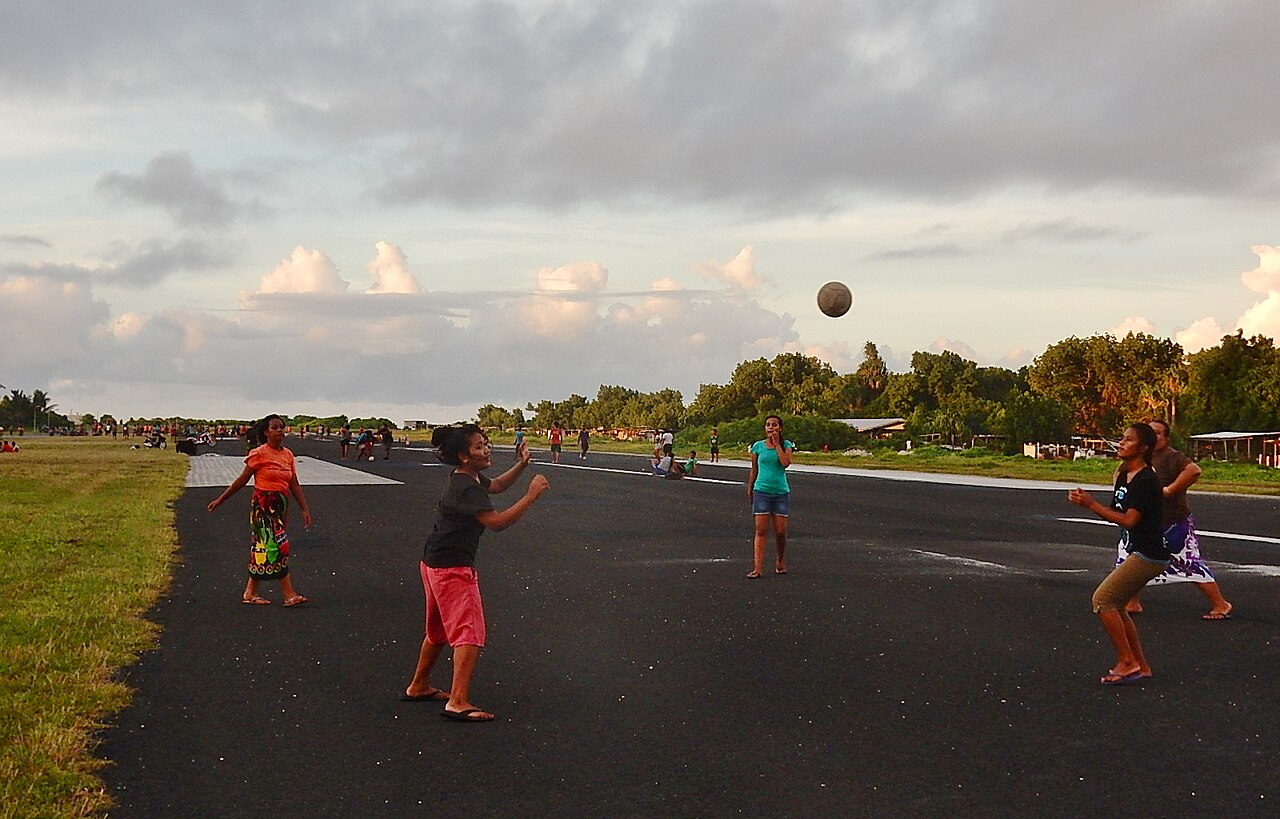
The frame first: 9 atolls and reef islands, 26 km² of land (the world's 4th-smallest country), about 10,600 people (2022 census), and a highest point around 15 ft (4.6 m). Funafuti holds the country's machinery and some 6,000 people, but the first-timer's deeper list starts on Fongafale itself, with the war. In 1942–43 the U.S. Seabees built Funafuti's airfield (the runway you land on) and David's Drill — the borehole site near today's strip — preserves the spot where Royal Society scientists drilled the atoll's core in 1896–98 to test Darwin's theory of atoll formation. Bunkers, ammunition stores and aircraft remains dot the islets (the lagoon holds B-24 wrecks diveable by arrangement; Nanumea, Nukufetau and Nanumanga also got wartime strips — the country's WWII geography is a course in itself). Then the small nation's paperwork charms: the Tuvalu Philatelic Bureau (Funafuti's stamp office, issuing the elaborate commemoratives that collectors worldwide buy — for decades philately ranked among the state's signature exports alongside the .tv domain), the Women's Handicraft Centre (mats, fans, model canoes), the national library and archives, and the maneapa circuit — every island's great meeting house, where the falekaupule governs and the fatele (standing dance, drummers behind, dancers' hands telling the story) performs the country's memory.
The outer islands are the second country: the government ships (MV Nivaga III and MV Manu Folau) sail from Funafuti every 3–4 weeks on round trips that take days to weeks, berthing you in a cabin if fortune smiles or on deck as Tuvaluans do, and each atoll has its argument. Nanumea (northernmost): the WWII airfield lagoon, the country's most traditional maneapa culture and its own conservation area (a 2.02 km² no-fishing MPA since 2006). Nanumanga: the "fire caves" — underwater caves discovered by divers in 1986 some 40 m down, containing evidence of human fires lit thousands of years ago when sea level stood far lower — a site that recalibrated Pacific settlement science (visit by arrangement; the caves themselves are deep-diving archaeology, the story is told on land). Nukufetau: the Motulalo islet airstrip relics and one of Tuvalu's prettiest lagoons. Nui: the atoll that speaks Gilbertese (Kiribati's language) — settled from the Gilberts, a linguistic island inside the country. Vaitupu: the largest island (5.6 km²), Motufoua Secondary School (the national school, founded 1905 by the London Missionary Society), and the softball-cricket (kilikiti) heartland. Niutao and Niulakita (southernmost, the "highest" land at about 4.6 m) for the completist. A first trip can't hold them all — the ship schedule picks 1 or 2 for you, which is precisely the Tuvaluan way.
Picture the place
A fatele in the maneapa: rows of men drumming and chanting at full voice, the dancers' arms rising in unison under the great roof, and the whole island, it seems, seated cross-legged around the floor.
The easily missed detail
Kilikiti — Tuvalu's version of Samoan cricket — is the country's true national sport and its matches (played between villages and islands, with feasting obligations for the hosts) can commandeer a community's calendar for weeks; a ship that lands you mid-match lands you in a festival. The second detail is David's Drill's double life: the drill site is simultaneously a monument to Darwin being right (the cores found shallow-water coral rock hundreds of meters down, proving slow subsidence) and a working piece of the climate story — the same atoll that proved how islands sink gently is now the place measuring how fast the sea comes back. Tuvalu's digital-nation programme (the "Future Now" project: archiving the nation — its land records, culture, even governance — into a digital state, announced as sea levels rose) makes the philatelic bureau, the maneapa dances and the island songs exhibits in a deliberate act of national preservation: what you are watching is a country backing itself up.
A practical rhythm
- War-and-science morning — David's Drill, the bunkers and the philatelic bureau in 1 Fongafale circuit by bicycle
- Ship for 1 atoll — Take whichever of Nanumea or Nukufetau the sailing serves, for as long as it serves it
- Maneapa by invitation — Ask your host about fatele practice nights rather than headline performances
What could complicate the plan
The ship is the country's romance and its risk: sailings shift with weather, cargo and government business; a round trip can stretch past your permit's tidy month (extensions exist at the Funafuti immigration office — arrange before you sail, in person); seasickness on the ocean legs is a near-certainty for the unmedicated; and outer-island stays mean guesthouse-simple living (rainwater tanks, solar hours, no stores to speak of — carry what you need, including any medication, from Funafuti). WWII sites carry the standard warning of these islands (unexploded ordnance survives in the ground and lagoon — photograph, don't handle, and take a local guide whose family knows where things lie). The fire caves are not a tourist dive (40 m down, archaeology, permission-bound) — the expectation to manage is that Nanumanga's wonder is its story and its topside island, not an underwater tour. And the conservation map is growing quietly (4 MPAs and 4 locally managed areas on outer islands by 2024), which means "just fish anywhere" is never the assumption — on every island, ask the kaupule what is tapu this season.
What to do next
Check the shipping board at the Funafuti wharf on day 1, align your month with one outer-island sailing, and bicycle the war sites before the first ship leaves.
Sources
- Tuvalu historical record — the Royal Society borings (1896–98) and David's Drill; the U.S. airfield build (1942–43); the Nanumanga underwater caves (found 1986; ancient fire evidence at about 40 m depth)
- Tuvalu Maritime / government shipping — MV Nivaga III and MV Manu Folau sailings every 3–4 weeks to the outer islands
- Government of Tuvalu — the Philatelic Bureau; the Future Now digital-nation project; marine protected areas (Funafuti 1996/1999; Nanumea MPA 2006, 2.02 km²; 4 MPAs + 4 LMMAs by 2024)
- Tuvalu National Statistics Office, 2022 census — population about 10,600