Uzbekistan country guide Trip planning
How can I plan a memorable first trip to Uzbekistan without rushing?
The short answer
Ten to twelve days on a single west-to-east line — Tashkent, a flight out to Khiva, then Bukhara and Samarkand by rail with three nights in each of the last two — using the Afrosiyob fast trains as the spine, bazaar mornings as the ritual, and one open day with nothing in it.
The answer, with local context
The geometry first. Uzbekistan's sights form a line, not a cluster: Tashkent in the east, Samarkand 186 miles (300 km) southwest, Bukhara another 174 miles (280 km), and Khiva 280 miles (450 km) beyond that across the Kyzyl Kum. Rushing is what happens when travelers fight that line; the unhurried solution is to fly the long leg and ride the short ones. Uzbekistan Airways flies Tashkent to Urgench (Khiva's airport) in about 90 minutes — start there, then move east by train in the direction of improving monuments, ending at Samarkand and Tashkent. The Afrosiyob high-speed trains — Spanish Talgo sets running since 2011, at up to 155 mph (250 km/h) — cover Tashkent–Samarkand in about two hours and Samarkand–Bukhara in roughly 90 minutes, and they are the trip's backbone; the older Sharq Express and the desert crossing to Urgench (a slow train or shared car over 6–7 hours if you reverse the plan) fill the gaps.
Then the arithmetic of nights. Tashkent earns two: one for the Soviet-modern capital — the 1977 metro's palace stations, the Chorsu dome, the Amir Timur Museum — and one for the Fergana day trip or the Chimgan mountains. Khiva earns two inside its walls, because Itchan Kala at dawn and dusk, emptied of day-trippers, is a different city from the one at noon. Bukhara earns three: it is the meditative heart of the route, a city of teahouse afternoons around the Lyab-i Hauz, and it punishes one-night stands. Samarkand earns three, with the Shakhrisyabz day trip over the pass in one of them. That is ten nights; twelve adds Nukus or the desert yurt night at Lake Aydarkul, either of which travelers consistently name as the trip's surprise summit.
The paperwork has largely dissolved. Since February 2019 most EU, UK and many other nationals enter visa-free for 30 days; Americans and others use a simple e-visa applied for online in advance. Hotels handle the registration that once haunted travelers — keep the slips they give you. Money is the sum (carry some cash; cards work in the cities' hotels and better restaurants, ATMs are common in Tashkent and thinner in Khiva). Trains are the one hard deadline in the whole system: Afrosiyob seats, especially the morning departures, sell out, so book through the railway's e-ticket site or app as soon as dates fix — the popular trains go on sale about 60 days out. And build the day's shape the Uzbek way: monuments at opening, bazaar before ten, a long shaded lunch, the second sightseeing shift from four o'clock, when the light turns and the heat — in season — breaks.
Picture the place
Bukhara, third evening, nothing scheduled: you are back at the same Lyab-i Hauz teahouse as the first night, the mulberry trees have their lamps on, the oshpaz's assistant recognizes you, and the city has quietly stopped being an itinerary and started being a place you are in.
The easily missed detail
Leave one full day unassigned in the middle of the trip — Bukhara absorbs it best. Unplanned days in Uzbekistan have a way of filling with the things no guidebook can schedule: a workshop invitation in a Bukhara courtyard, an extra hour with a Rishton potter, a wedding plov a hotelier insists you attend. The empty day is not slack; it is the mechanism by which the memorable happens.
A practical rhythm
- Days 1–2 — Tashkent: metro, Chorsu at breakfast, the Khast Imam Quran, one museum; sleep early and fly west.
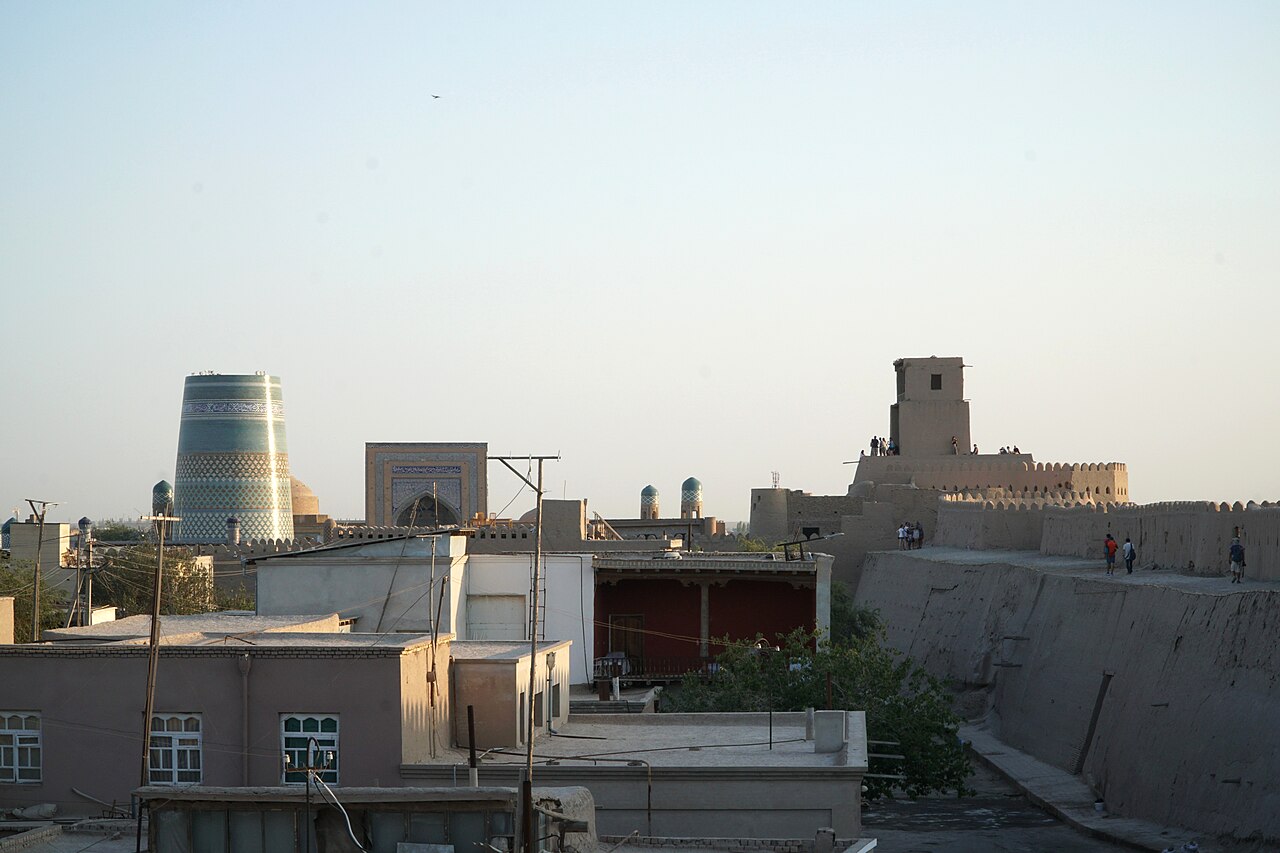
- Days 3–4 — Khiva inside the walls: dawn on the ramparts, the palaces at midday, the Juma Mosque's columned hush at closing.
- Days 5–10 — Bukhara (3) and Samarkand (3+) by Afrosiyob: one headline monument before ten each day, bazaars and chaikhanas after, Shakhrisyabz on Samarkand's middle day.
What could complicate the plan
The desert leg breaks itineraries that try to drive it: Bukhara–Khiva by road is six to seven hours of Kyzyl Kum, tolerable once, ruinous twice — fly or train one direction. Train availability is the trip's true scarce resource, ahead of hotel rooms. Summer heat converts the whole plan into a dawn-and-dusk proposition from June to August; winter adds frozen charm and subtracts the teahouse life. And the route's pleasures are sequential: travelers who reverse it (Samarkand first) often find Bukhara's quieter register reads as anticlimax, which the west-to-east build avoids.
What to do next
Fix dates in October (or late April), buy the international flights, book the Afrosiyob trains the day the window opens, and hold the Bukhara day in the middle resolutely empty.
Sources
- Uzbekistan Railways / Afrosiyob — Talgo high-speed services since 2011, up to 250 km/h (155 mph): Tashkent–Samarkand in about 2 hours, Samarkand–Bukhara about 1.5 hours; e-ticket booking opening roughly 60 days ahead
- Uzbekistan Airways — Tashkent–Urgench domestic flights of about 90 minutes serving Khiva
- Government of Uzbekistan entry rules — visa-free entry for 30 days for most EU, UK and many other nationals since February 2019; an e-visa system for other nationalities including US citizens; hotel-issued registration slips
- Route distances — Tashkent–Samarkand 300 km (186 mi), Samarkand–Bukhara 280 km (174 mi), Bukhara–Khiva about 450 km (280 mi) across the Kyzyl Kum