Uzbekistan country guide Places and experiences
What should a first-time traveler see in Uzbekistan beyond the obvious highlights?
The short answer
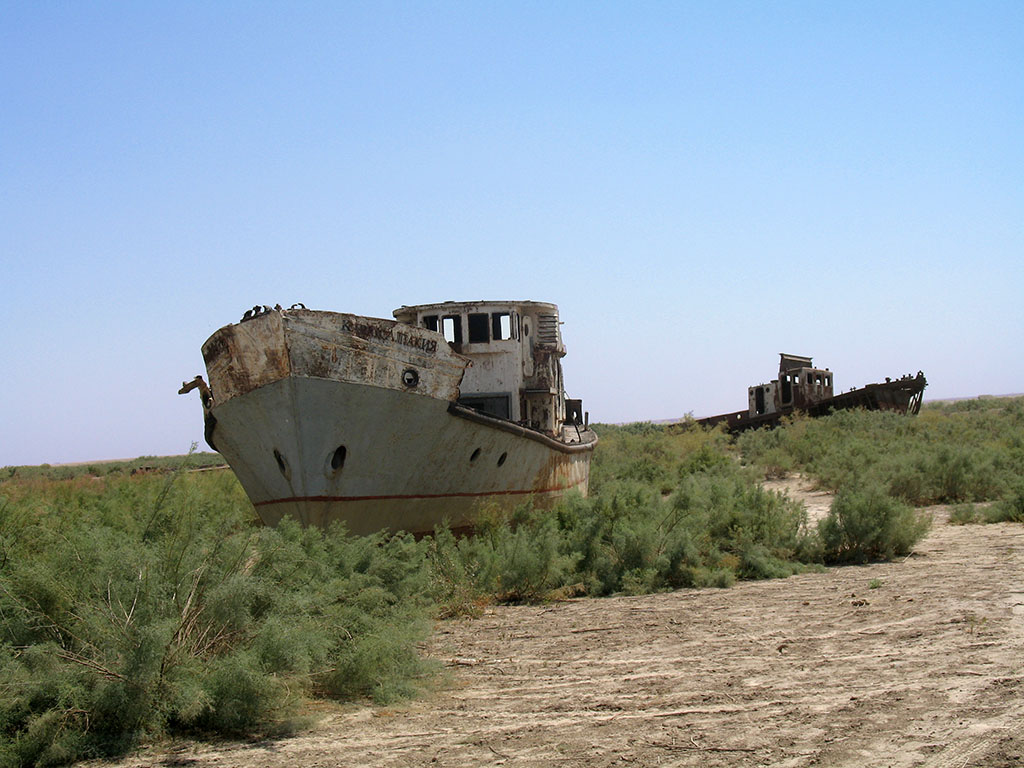
The avant-garde art rescued in Nukus, the beached ships of Moynaq on the vanished Aral shore, Khiva's intact walled city, the silk and ceramic workshops of the Fergana Valley, and Timur's colossal unfinished palace gate at his birthplace, Shakhrisyabz.
The answer, with local context
The obvious highlights — Samarkand's tilework, Bukhara's minaret, Tashkent's avenues — are obvious because they are magnificent, but Uzbekistan is one of those countries whose second list outranks other nations' first. Start at the top of the strangeness scale, in Nukus, capital of the Karakalpakstan autonomous republic. The Savitsky Museum there holds one of the world's great collections of Russian and Soviet avant-garde art — around 90,000 works in the full holdings — assembled by Igor Savitsky, who from the 1950s rescued paintings the Soviet state had banned and buried their artists, Alexander Volkov and Ural Tansykbayev among them, preserving a lost chapter of modernism in a desert city few censors visited. It is routinely called the Louvre of the steppe, and it alone justifies the flight northwest.
Three hours beyond Nukus by road lies Moynaq, once a fishing port and cannery town on the Aral Sea. In 1960 the Aral was the world's fourth-largest lake, about 26,300 square miles (68,000 km²); Soviet irrigation diversions of the Amu Darya and Syr Darya shrank it by some 90 percent, and the shoreline has retreated roughly 95 miles (150 km) from Moynaq's rusting fleet, which now sits on sand and scrub in rows — a fishing harbor without water, the single most haunting landscape in Central Asia. Pair it with the Elliq Qala ("Fifty Fortresses") of ancient Khorezm on the way back south: Ayaz Kala and Toprak Kala, mud-brick citadels of the 4th century BCE to 7th century CE riding desert ridges, with yurt camps below them and Lake Aydarkul's swimmable shore for the following night.
Then the living crafts. Khiva's Itchan Kala — a whole walled city of madrassas, mosques and palaces preserved as an open-air museum — is somehow still under-visited beside Samarkand: climb its walls at dusk, and count the landmarks, from the squat turquoise Kalta Minor, a minaret abandoned unfinished in 1855 that was meant to dwarf everything, to Islam Khoja's 1910 minaret, at 187 feet (57 m) the tallest in the country, and the Juma Mosque's forest of 213 carved wooden columns. In the Fergana Valley east, Margilan's Yodgorlik factory still weaves silk ikat — khan-atlas, "king's silk" — by hand through every stage from cocoon to loom; Rishton's potters fire the blue-glazed ceramics their town has made for a thousand years; Kokand keeps the Khudoyar Khan Palace (built 1863–1873), its tiled facade fronting what were 119 rooms and seven courtyards. And Shakhrisyabz, Timur's birthplace in 1336, holds the Ak-Saray palace gate: two ruined towers of 1380–1404 that once carried his boast in tile — "If you challenge our power, look at our buildings." Even the capital hides a second city: Tashkent's Khast Imam complex guards a 7th-century Quran of Uthman among the world's oldest, and its 1977 metro — Central Asia's first — runs stations like small palaces, photography permitted since 2018.
Picture the place
At Moynaq the gangway of a beached trawler leads down not to water but to camel scrub; below the hull, in what was harbor mud, saxaul bushes have rooted, and the town's memorial obelisk stands where the waves used to arrive.
The easily missed detail
The desert fortresses run on silence. Ayaz Kala at dawn — before the day tours' minibuses reach the Kyzyl Kum — holds a 2,000-year-old citadel, a yurt camp waking below it, and no sound but wind in the walls. Sleep one night in the yurts and the site's scale, invisible at noon, becomes the point.
A practical rhythm
- The northwest — Fly Tashkent–Nukus for the Savitsky, sleep there, then the Moynaq day and the Elliq Qala fortresses on the drive or flight out: three days that most itineraries never spend.
- The east — A Fergana loop from Tashkent: Margilan's silk, Rishton's kilns, Kokand's palace facade, home by the Kamchik pass road or the valley train.
- The south — Shakhrisyabz as a full day from Samarkand, over the mountain pass, with Termez — Buddhist stupas of the Kushan era at Fayaz Tepe on the Afghan border river — for the truly thorough.
What could complicate the plan
Distances are the tax: Nukus is 780 miles (1,255 km) from Tashkent, and the northwest extension needs domestic flights and a tolerance for long desert drives. The Savitsky's masterpieces rotate — not all 90,000 works can hang — so temper single-painting pilgrimages. And the Aral shore is an emotional visit, not a scenic one; travelers who go expecting beauty should be ready for what an ecological catastrophe actually looks like at ground level.
What to do next
Add four days to the classic route — two for the Nukus–Moynaq arc, two for the Fergana — and the trip stops being the standard postcard circuit.
Sources
- The Savitsky Museum, Nukus — holdings of around 90,000 items, the Igor Savitsky collection of banned Russian and Soviet avant-garde art (Volkov, Tansykbayev), assembled from the 1950s onward
- Aral Sea record / UN sources — the Aral's 1960 extent of about 68,000 km² (26,300 sq mi), then the world's fourth-largest lake; a shrinkage of about 90 percent, with Moynaq's shoreline retreating on the order of 150 km
- UNESCO / Khiva — Itchan Kala (1990): the Kalta Minor, begun 1851 and left unfinished in 1855; the Islam Khoja minaret (1910) at 57 m, Uzbekistan's tallest; the Juma Mosque's 213 wooden columns
- Fergana Valley crafts — Margilan's Yodgorlik silk factory and khan-atlas ikat; Rishton's ceramics; Kokand's Khudoyar Khan Palace (1863–1873)
- Shakhrisyabz (UNESCO, 2000) — Timur's birthplace (1336) and the Ak-Saray palace portal of 1380–1404; Tashkent's Khast Imam 7th-century Uthman Quran and the 1977 metro