Uzbekistan country guide When to visit
When is the best time to visit Uzbekistan for Samarkand?
The short answer
October — the desert summer that drives July averages near 99°F (37°C) in the south has let go, the melon and grape harvests are at the bazaars, and the same gentle month simultaneously unlocks the whole national route: Bukhara's domes, Khiva's walls and the Fergana workshops.
The answer, with local context
Uzbekistan is a doubly landlocked continental country — one of only two on earth — and its weather has a desert's manners: enormous swings and no maritime mercy. The national climate reporting puts July averages near 99°F (37°C) in the far south around Termez and 90 to 91°F (32 to 33°C) over the northern plateau, with absolute maxima of 118 to 122°F (48 to 50°C) in the south. Winter reverses the cruelty: January averages run from 36 to 37°F (2 to 3°C) in the south down to 14 to 18°F (−10 to −8°C) in the northwest, Khiva's open steppe wind is harsher still, and the monuments stand in a brown, leafless cold. The country's traveling seasons are therefore the two shoulders — mid-April to early June, and mid-September through October — and between them October is the connoisseur's choice for a Samarkand-anchored trip.
The anchor itself argues the month. Samarkand's own monthly normals — means across the whole day, not afternoon peaks — fall from 82°F (27.5°C) in July to 58°F (14.4°C) in October, and October's rain amounts to 0.7 inches (17.1 mm): the Timurid blue — which is a glaze, and photographs as one only in dry, low-angled light — is at its most saturated exactly then. One designation frames the whole itinerary: Uzbekistan holds seven World Heritage properties, and they are strung along the one natural route — Itchan Kala in Khiva (1990, the country's first inscription), Historic Bukhara (1993), Shakhrisyabz (2000), Samarkand (2001), the transnational Western Tien-Shan (2016) and the 2023 pair, the Zarafshan-Karakum Silk Roads corridor and the Cold Winter Deserts of Turan. October is the month that makes visiting all four historic cities in one trip comfortable rather than dutiful.
Spring is the honest rival: April and May bring poppies to the foothills, mulberries, and Samarkand's wettest weeks by its modest standards, and travelers who love markets green over markets golden choose it. But October adds the harvest — bazaars stacked with melons, grapes, pomegranates and the year's fresh dried fruit — and it removes spring's dust storms and sudden cold snaps. For Khiva in particular, at the far end of a long desert road from Bukhara, October is the difference between a walled city you explore at noon and one you survive between air-conditioned stops.
Picture the place
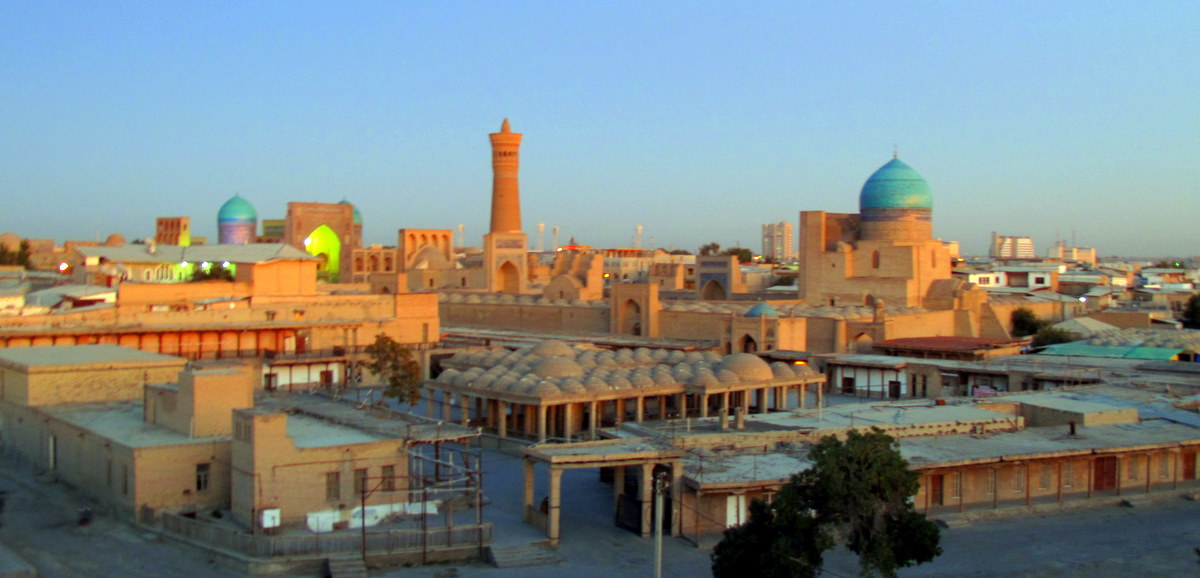
An October evening in the Bukhara old town, halfway along the classic route: the Kalyan minaret's bands of patterned brick turn from honey to rose over the mosque courtyard, swallows pour around the lantern gallery, and the teahouse tables around the Lyab-i Hauz pool fill in long sleeves, not coats.
The easily missed detail
The harvest is a menu, not a backdrop. Uzbekistan grows celebrated melons — the torpedo-shaped Mirza melons of the Khorezm and Bukhara oases among them — and October is when the bazaar melon-sellers are cutting free tastes of the year's best fruit; the same weeks bring the first qazi, fresh grapes by the armful and pomegranate juice pressed to order. Aim the trip's bazaar mornings at October and the country's agriculture becomes one of its sights.
A practical rhythm
- Start — Tashkent and the Fergana Valley in the month's first days, workshops and bazaars still in full harvest swing.
- Middle — Bukhara for three nights, when its unheated-in-winter madrassa hotels are at their kindest.
- Finish — Samarkand last and longest, the anchor city in the year's clearest light, with a day trip south to Shakhrisyabz over the Takhta-Karacha pass before the first snows threaten it.
What could complicate the plan
October's virtues are known: the Afrosiyob high-speed trains sell out their best departures weeks ahead in season, and Bukhara's boutique hotels in the old Jewish-quarter houses book early. The month is not uniformly mild — the northern desert cools far faster than Termez in the south, so the packing is layers, not a single wardrobe. And the Navruz alternative tempts: the March 21 spring festival is a genuine national celebration, but it sits inside the year's least predictable weather window.
What to do next
Book the October loop in the Tashkent–Khiva–Bukhara–Samarkand order (flying out to Urgench for Khiva, training back east), reserve the trains the day the booking window opens, and give Samarkand the final three nights.
Sources
- UNESCO World Heritage List, Uzbekistan — Crossroads of Cultures (2001), Western Tien-Shan (2016), Silk Roads: Zarafshan-Karakum Corridor (2023) and Cold Winter Deserts of Turan (2023)
- Japan Meteorological Agency, climatological normals for the Samarkand station — monthly means, not daytime highs: 27.5 °C in July against 14.4 °C in October, with October precipitation of 17.1 mm (station printed in-page at 39.63°N, 66.95°E, 725 m)
- Centre of Hydrometeorological Service of Uzbekistan (Uzhydromet), Third National Communication under the UNFCCC — July averages of about 37 °C in the south and 32–33 °C on the northern plateau, January averages of +2 to +3 °C in the south and −8 to −10 °C in the northwest, and absolute maxima of 48–50 °C in the south (Tashkent, 2016)