Vatican City country guide When to visit
When is the best time to visit Vatican City for St Peter's Basilica?
The short answer
Mid-October — Rome's ottobrata warmth without summer's crush, the basilica open to 8 p.m. and its dome lit until 6 p.m., the Wednesday audiences outdoors in the square, and the crowds a full season below their Easter and August peaks.
The answer, with local context
Vatican City is the world's smallest state (44 hectares by the Holy See's own figure, 882 residents at the end of 2024, created by the Lateran Treaty of February 11, 1929) and the only country inscribed whole on UNESCO's World Heritage List (1984) — which means its "national" seasonality is really the seasonality of 3 institutions: a working basilica, a museum complex and a papal calendar. October reads all 3 well. The Vatican Museums keep their long timetable (Monday–Saturday 8:00–20:00, last entry 18:00, per the official site; the standard ticket is €20, or €25 booked online including the €5 booking fee) with October's weekday crowds a fraction of summer's; the general audiences on Wednesday mornings are held outdoors in St. Peter's Square in the mild weeks (they retreat to the Paul VI Hall in deep winter); and the year's great pressure spikes — Holy Week and Easter, the June 29 feast of Saints Peter and Paul, Christmas — are all elsewhere on the calendar. Rome's weather is the famous ottobrata romana: days in the low-to-mid 70s °F (22–24°C), evenings built for the square. And October carries a specific published hinge: the basilica's dome keeps summer hours (7:00–18:00) until about October 25, when it drops to the winter pattern (7:30–17:00) — the month straddles the last long evenings of the year.
Now the anchor. St. Peter's is free, and that fact organizes everything: entry to the basilica costs nothing and needs no ticket (the official basilica site says so plainly), with security lines at the colonnade as the only toll. It opens daily at 7:00 (to 20:00 in summer season, 19:00 in winter) — so October mornings offer the basilica's true luxury, the first hour, when the Pietà chapel is quiet and the light comes low through the nave of the largest church in the world (its interior measures 694 feet, and the dome rises 447 feet to the cross). The dome is the separate, ticketed act: 551 steps all the way, or the elevator to the terrace and 320 steps beyond (€10 by stairs or €15 with the lift at the on-site desk), and October's air makes the climb an outing instead of an ordeal. The basilica closes to sightseeing on Wednesday mornings until about 12:30 when the audience is in the square — the scheduling fact every Vatican itinerary is built around.
The rivals make their cases liturgically. Holy Week is the basilica's maximum-intensity week (papal Masses, the Via Crucis at the Colosseum on Good Friday) and its maximum-crowd week; late January is the emptiest the Museums ever get, at the price of the audience indoors and the dome closing at 5 p.m.; the last Sunday of each month (the Museums open free, 9:00–14:00, last entry 12:30) is a false economy in every month — October's falls on the 25th in 2026, and it is the queue, not the saving, that defines it. October is the balanced answer: the church in ordinary time, the museums in their long hours, the square in shirtsleeves.
Picture the place
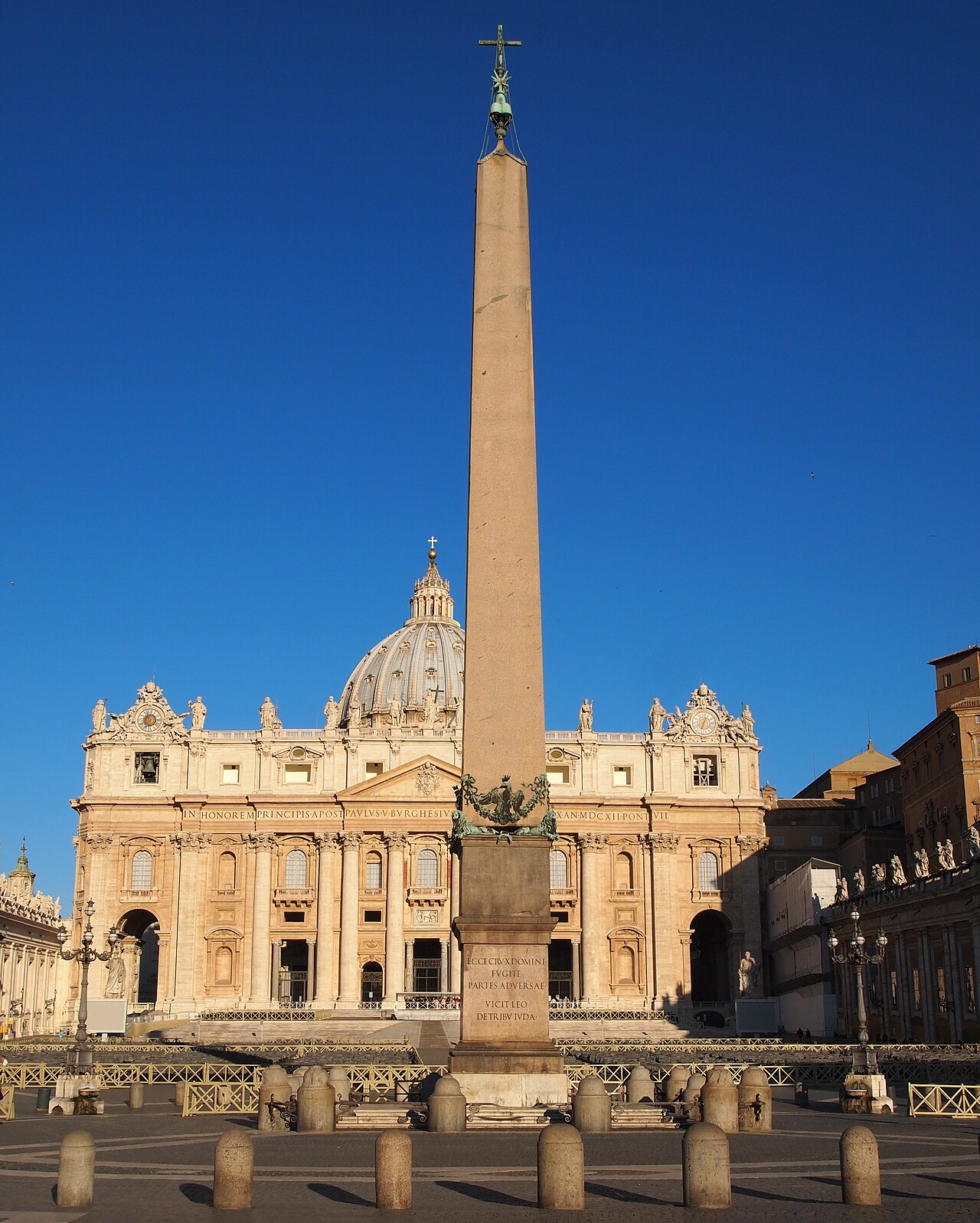
St. Peter's Square at 6:45 on an October evening: the colonnades in honey-colored light, the obelisk's shadow reaching across the paving, and the dome still holding the sun after the square has gone to shade.
The easily missed detail
The free basilica hides a paid clock: the dome's last entry runs well before the church closes, and its winter timetable (from late October) cuts the lantern by an hour — climbers who leave the dome for "later, after the Museums" in November find a closing door. The second detail is the Wednesday inversion: because the basilica shuts for the audience morning, Wednesday is paradoxically the best Museums day (the square's crowds are at the audience, not the galleries) and the worst basilica morning — the week rearranges itself around that one fact.
A practical rhythm
- Basilica at 7 — The first hour inside St. Peter's, before the tour groups clear security
- Wednesday for the Museums — The audience morning used as the galleries' quiet window, the basilica after 12:30
- Dome before dusk — The 551 steps climbed in the afternoon, down for the square's evening light
What could complicate the plan
October is not empty — it is Rome's conference-and-pilgrimage shoulder, and papal events (a canonization Sunday, a consistory) can fill the square and close the basilica at short notice; the official calendar is checked the week before, not the month. The dress code is enforced at both basilica and museums (shoulders and knees covered; refusals at security are final), and the basilica's rope lines reconfigure constantly for Masses — the nave is a working church first and a sight second. Weather has a vote: October's rains, when they come, are Rome's heaviest of the autumn, and the dome closes in high wind and lightning. Finally, the Jubilee of 2025 (the Holy Year that ran to January 6, 2026) permanently raised the baseline: timed booking for the Museums is now effectively compulsory at any season, and "walk-up October" survives only at the basilica's free door.
What to do next
Book the Museums' first entry on a Wednesday, keep a non-Wednesday morning for the basilica at 7, and check the papal calendar before fixing either.
Sources
- Vatican Museums (museivaticani.va) — the official timetable (Monday–Saturday 8:00–20:00, last entry 18:00; last Sunday free 9:00–14:00, last entry 12:30) and the €20 ticket (€25 online with the booking fee)
- St. Peter's Basilica official site (basilicasanpietro.va) — free entry; daily hours; the dome's 551 steps (320 after the lift), its on-site prices and its seasonal hours (to 18:00 until late October, then 17:00)
- Holy See / Vatican City State — the state's area (44 ha), population (882, end of 2024) and Lateran Treaty foundation (1929)
- UNESCO World Heritage Centre — Vatican City inscribed as an entire state (1984)