Venezuela country guide When to visit
When is the best time to visit Venezuela for Angel Falls?
The short answer
July — inside the June–December window when the Carrao and Churún rivers run high enough for the curiara boats to reach Angel Falls at all, with the falls near full power: but read the condition first — Venezuela stands at Level 3 (Reconsider Travel) since March 2026, and this is a trip for the traveler who has weighed that advisory and goes with specialist operators, or not at all.
The answer, with local context
The condition, stated exactly as the U.S. Department of State states it: Venezuela's advisory was downgraded from Level 4 (Do Not Travel) to Level 3 (Reconsider Travel) on March 19, 2026, following the country's political transition (the advisory was re-issued May 16, 2026) — the first easing in 7 years — while several regions remain Level 4 (the Colombia border, Amazonas, Apure, Táchira, Guárico, much of Aragua and rural areas of Bolívar). The U.S. Embassy in Caracas resumed operations on March 30, 2026 after its 7-year closure, but its consular section provides emergency services only, with very limited help outside Caracas and U.S. visa services still run from Bogotá; the UK's FCDO advises against all but essential travel to most of the country. U.S. citizens need a Venezuelan visa arranged before travel (through the online Cancillería process — there is no functioning Venezuelan consulate in the U.S. and no visa on arrival; entering without one has historically risked detention). June 2026 added a fresh caution: earthquakes on June 24, 2026 damaged transport and infrastructure in the country's northwest-center, a recovery this guide's planning answer weighs. Season verdicts below apply only to a trip that clears that bar.
Within it, the hydrology is law: Angel Falls — Kerepakupai Vená to the Pemón — is the world's tallest uninterrupted waterfall (979 m / 3,212 ft total, its main leap 807 m), pouring off Auyán-tepui in Canaima National Park (UNESCO 1994; some 30,000 km² of tepuis and savannah, Venezuela's 2nd-largest park). The falls are reached only in the wet season: Canaima village (air-only access — Conviasa flies Caracas–Canaima about twice weekly, currently Thursday and Sunday patterns) then a motorised curiara 4–6 hours up the Carrao and Churún rivers and a 1-hour forest hike to the Mirador Laime viewpoint — and the boats simply cannot run in the dry season (December–April), when rivers drop, passengers walk the shallows, and the falls themselves can thin to a ribbon. July balances the curve: rivers fully navigable, the falls thundering at near-peak volume (August–September run wetter still but with the tepui summits most often lost in cloud), camps running their established season. The published tariff at the Canaima airstrip: a park entry fee of about US$40 per visitor (INPARQUES, paid on arrival, valid for the stay) — and a yellow fever rule with teeth: proof of vaccination is required to enter the park, and travelers without documentation are vaccinated at the airport on the spot.
Picture the place
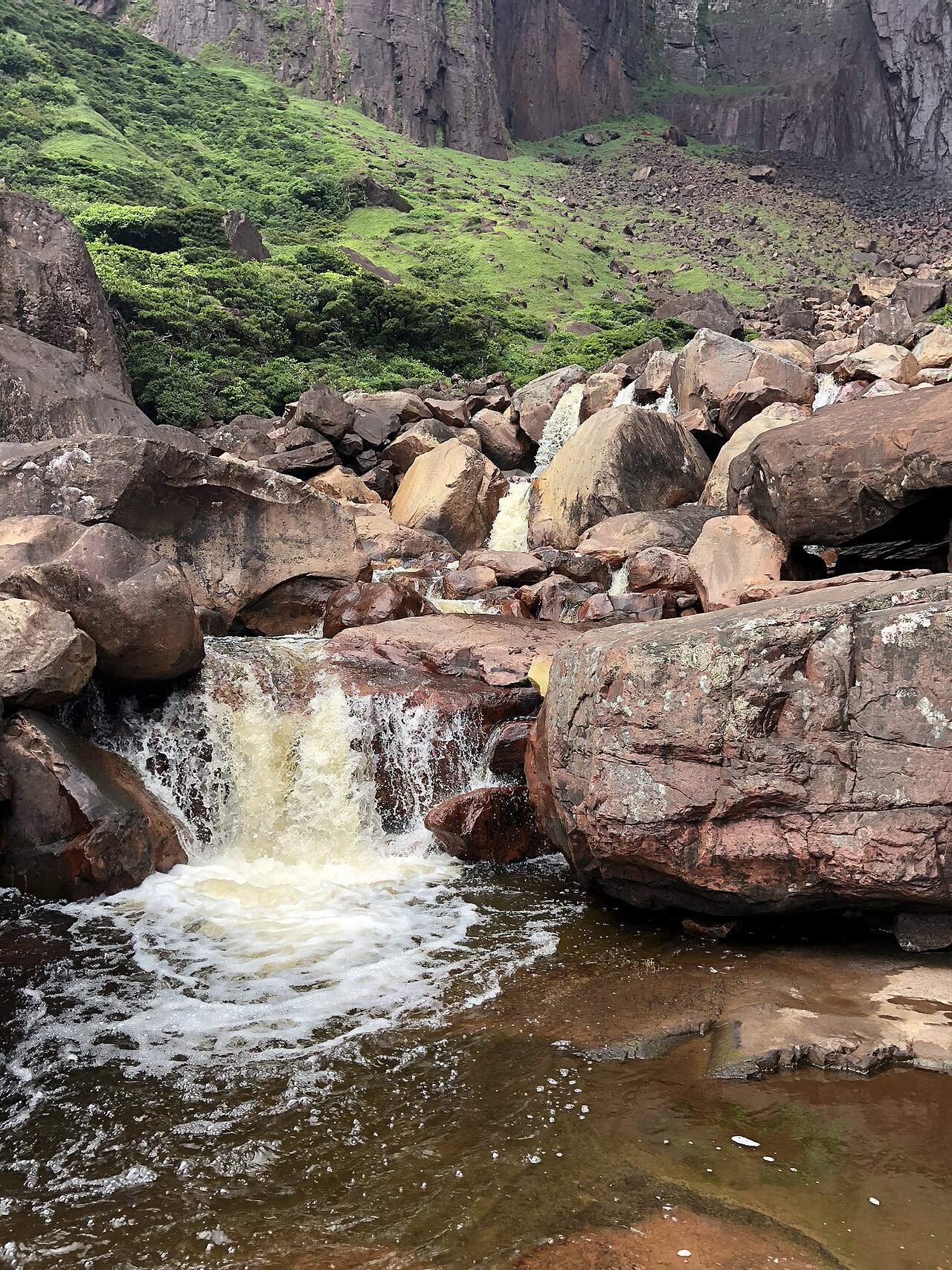
The curiara at dawn below Auyán-tepui: the Churún running tea-brown and high, macaws crossing to the far bank, and ahead — barely audible over the outboard — a white thread falling 807 m out of the cloud into the Canyon of the Devil.
The easily missed detail
Angel Falls' name is the Pemón's standing correction: the falls were Kerepakupai Vená ("waterfall of the deepest place") for centuries before the American bush pilot Jimmie Angel saw them in 1933 and landed atop the tepui in 1937 (his plane, El Río Caroní, sat on the summit until a 1970 helicopter recovery and now sits at Ciudad Bolívar's airport museum) — Venezuela officially restored the Indigenous name in 2009, a duality every good Pemón guide will explain on the river. The second detail is the lagoon you land beside: Canaima Lagoon's own falls (Hacha, Ucaima, Golondrina) and El Sapo — where the path runs behind the water curtain — make the village days a waterfall trip in themselves, not a waiting room.
A practical rhythm
- July, 3 nights minimum in Canaima — Fly in, river day to the falls with a hammock-camp night at Isla Ratón, lagoon day third
- Visa before flights — The e-visa processing runs 1–4 weeks; non-refundable bookings wait for the visa in hand
- Overflight as insurance — The scenic flight past the falls' face on the clear morning, whichever it is
What could complicate the plan
The advisory stack is the plan: Level 3 nationally (crime, kidnapping, wrongful-detention history, poor health infrastructure) with Level 4 regions — and Bolívar's rural areas appear on the Level 4 list, which is why Canaima trips run exclusively as Pemón-community packages with established operators on the fly-in circuit, never as independent travel; verify the current advisory's exact Bolívar wording before booking, and take STEP enrolment and evacuation insurance (with Venezuela explicitly covered) as non-negotiable. Consular thinness persists (embassy reopened for emergencies only; nothing routine outside Caracas; the June 2026 earthquake recovery still strains infrastructure and emergency services in affected regions). Logistics are brittle inside the park too: Conviasa's twice-weekly pattern can shift, fuel and weather scrub flights, river levels can cancel boats even in season (too-high water after extreme rain closes the Churún as surely as drought), and the summit view is a lottery (Auyán's top hides in wet-season cloud for days — the base experience, not the postcard, is the product). Money runs on U.S. dollars in cash for the interior (small bills; cards unreliable outside Caracas' formal sector), and the yellow fever rule is enforced at the airstrip (carry the certificate; the on-the-spot vaccination is real but costs you your arrival day).
What to do next
If — and only if — the advisory math works for you: start the visa process, then book a July Canaima package with an established operator, Pemón-guided, 3 nights minimum.
Sources
- U.S. Department of State, Venezuela (advisory reissued May 16, 2026; Level 3 nationally) — downgraded from Level 4 on March 19, 2026 after the political transition; Level 4 areas (Colombia border, Amazonas, Apure, Táchira, Guárico, Aragua, rural Bolívar); Embassy Caracas resumed operations March 30, 2026 (emergency services only); June 24, 2026 earthquake damage noted
- UNESCO — Canaima National Park (inscribed 1994; about 30,000 km²); Angel Falls 979 m total height, 807 m main drop
- INPARQUES / Canaima operators — park entry about US$40 on arrival at Canaima; yellow fever proof required (vaccination available at the airport); curiara access only in the June–December river season; Conviasa Caracas–Canaima patterns
- UK FCDO — advises against all but essential travel to most of Venezuela; against all travel near the Colombia border and to Zulia