Worldwide travel / Worldwide When to visit
What should I consider before choosing a spring flower destination?
The short answer
Choose by the forecast system, not the postcard: the reliable flower trips are the ones with published bloom predictions, a bloom window of weeks rather than days, and a destination worth visiting if the flowers mistime.
The answer, with local context
Flowers are a perishable event with a marketing department, and the planning differs by bloom type. Forecast blooms are the safest: Japan runs the world's most developed prediction industry for cherry blossom (the meteorological agencies publish forecast maps from January; the season marches north over roughly 2 months, late March in Kyoto to early May in Hokkaido; Kyoto recorded its earliest full bloom of the modern record on March 26, 2021 — the warming trend in one datum), and Washington's National Park Service forecasts the Tidal Basin's peak bloom (the 1912 gift trees from Japan) each spring, defining peak as 70% of blossoms open. The managed displays are safer still: the Netherlands' Keukenhof plants some 7 million bulbs for a window of 8 weeks (roughly late March to mid-May) so something is always performing, and the bulb fields around it follow the same professional calendar.
Wild blooms are the gamble category: desert superblooms (California's Anza-Borrego among them) need a wet winter and announce themselves weeks, not months, ahead; South Africa's Namaqualand daisies (August–September, the southern spring) vary by rainfall within a short season; lavender is not a spring flower at all (Provence peaks late June–July — the classic mistimed trip is the April lavender hunt). The checks that govern all of them: the bloom's historical window from the official source (park service, garden, prefecture) rather than influencers' best years; the altitude and latitude gradient you can exploit if you are early or late (in Japan, the season is a moving front you can chase by train; in the Alps, wildflower meadows climb with the snowline from May to July); the crowd mathematics (peak-bloom weekends at famous sites are national events — go midweek or accept the festival as the experience); and the fallback test — is the garden city, temple town or valley worth the trip at 30 percent bloom? Choose the destinations that pass that test and the flowers become a bonus with excellent odds instead of a single point of failure.
Picture the place
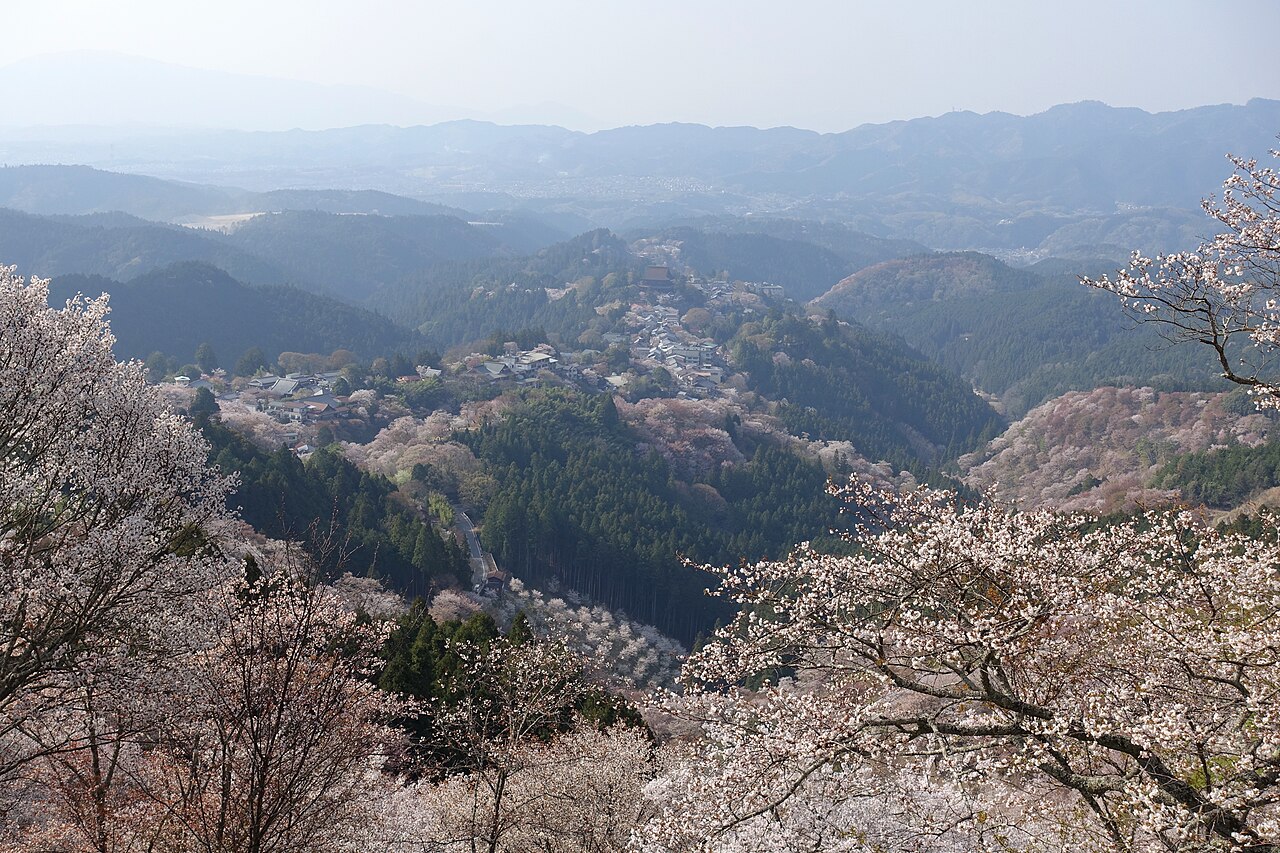
Mount Yoshino in April: not a tree but a mountainside in gradations of pink, 30,000 cherries planted over centuries — the bloom as a landscape, big enough to forgive a traveler's timing by days.
The easily missed detail
Bloom forecasts fail at the edges in a useful direction: warm rain and wind end a cherry season in days (the Japanese have a word for the petals on water, hanaikada), but the week before peak — buds swelling, first trees out — is often the connoisseurs' favorite and the crowd calendars ignore it. The second lever is the night programme: the famous blossom sites increasingly floodlight for yozakura (night cherry viewing), which doubles your daily chances against the weather.
A practical rhythm
- Forecast-checked, twice — The official bloom prediction read at booking and again 10 days out; the plan flexes to the second reading
- Gradient as insurance — Choose destinations where altitude or latitude lets you chase the bloom up or down within the trip
- Midweek at peak — The famous sites on their festival weekends belong to the nation; your visit is the Tuesday version
What could complicate the plan
Bloom trips fail at both ends of the forecast. Early failure is weather: a warm spell pulls a cherry season forward by a week or more, and the official predictions are revised repeatedly through the spring rather than fixed in January, which is why a non-refundable booking made on a January map is the classic mistake. Late failure is faster still, since warm rain and wind can strip a peak bloom in 2 or 3 days, so a trip pinned to 1 site on 1 weekend has exactly 1 chance. Crowds are the second complication, because peak bloom at a famous site is a national event with the transport and accommodation pricing of one: the Tidal Basin's peak is defined as 70 percent of blossoms open and is published in advance, which means the whole country arrives inside the same 4 or 5 days. Third, the managed displays run fixed seasons that do not flex with the weather — a bulb garden open for a window of 8 weeks closes on its published date whether the season came early or late, so a warm spring can leave the garden's final week standing behind the countryside's best.
What to do next
Pick the bloom with a published forecast and a multi-week window, book the midweek of its historical peak, and write the gradient escape (the higher town, the later valley) into the plan.
Sources
- Japan Meteorological Corporation / JMA — the sakura forecast system and Kyoto's record-early full bloom (March 26, 2021)
- US National Park Service — the Tidal Basin peak-bloom forecast and the 1912 gift trees
- Keukenhof — the 7 million bulbs and eight-week spring window
- SANParks — the Namaqualand flower season's rainfall dependence